Table of Contents
@[toc]
Introduction to Deep Learning
- AI is likened to the new electricity because, much like electricity did over 100 years ago, AI is transforming multiple industries such as: automotive, agriculture, and supply chains.
- The recent surge in deep learning can be attributed to: advancements in hardware, particularly GPU computing, which provides greater computational power; its successful application in key domains like advertising, speech recognition, and image recognition; and the digital age, which has generated vast amounts of data.
- The following diagram illustrates the iterative thinking process across different machine learning approaches:
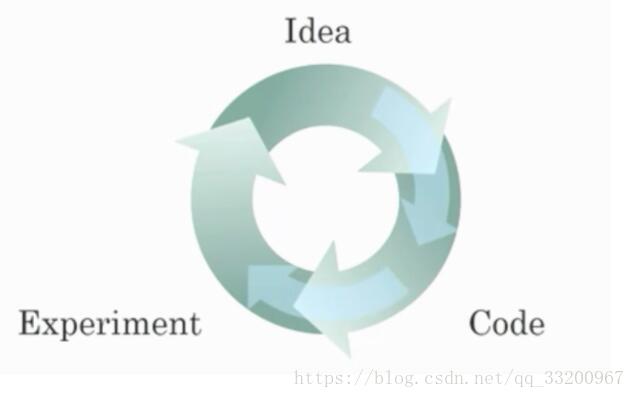
- This thought map enables rapid idea testing, allowing deep learning engineers to iterate on their concepts more swiftly.
- It accelerates the team’s ability to refine an idea. New progress in deep learning algorithms allows for better model training even without upgrades to CPU or GPU hardware. - Feature engineering is crucial for achieving good performance. While experience helps, building an effective model requires multiple iterations.
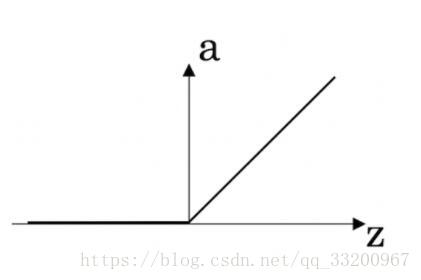
- The graph of the ReLU activation function is shown below:
- Cat recognition is an example of “unstructured” data. A demographic dataset that counts population, GDP per capita, and economic growth across cities is an example of “structured” data, as opposed to images, audio, or text.
- RNNs (Recurrent Neural Networks) are used for machine translation because translation is a supervised learning problem that can be trained with sequences. Both the input and output of an RNN are sequences, and translation involves mapping a sequence from one language to another.
- This hand-drawn graph has the x-axis representing the amount of data and the y-axis representing algorithm performance:
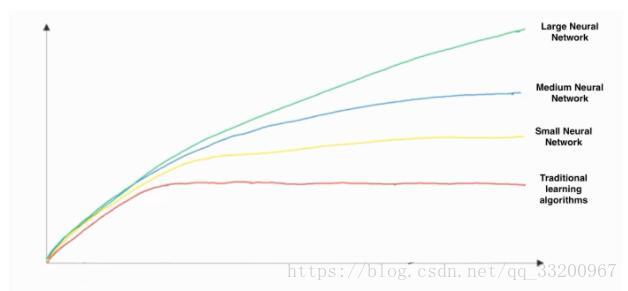
- The graph shows that increasing training data does not negatively impact algorithm performance; more data is always beneficial for the model.
- Increasing the size of a neural network typically improves performance. Larger networks generally outperform smaller ones.
Fundamentals of Neural Networks
- A neuron computes a linear function \( z = Wx + b \), followed by an activation function (sigmoid, tanh, ReLU, etc.).
- When directly computing matrices with numpy, unlike
np.dot(a, b), the operations use broadcasting rules.np.dot(a, b)follows standard matrix multiplication. - If
imgis a (32, 32, 3) array representing a 32x32 image with 3 color channels (red, green, blue), reshaping it into a column vector would be:x = img.reshape((32*32*3, 1)). - The “Logistic Loss” function is defined as:

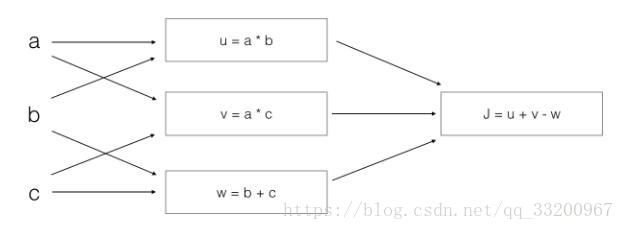
- The calculation process for the following image is:
[
\begin{align}
J &= u + v - w \
&= (a \cdot b) + (a \cdot c) - (b + c) \
&= a(b + c) - (b + c) \
&= (a - 1)(b + c)
\end{align}
]
Shallow Neural Networks
- \( a^{[l(2)]}_{12} \) represents the 12th element of the activation vector in the 2nd layer for a training sample.
- Each column of matrix \( X \) is a training sample.
- \( a_4^{[2]} \) denotes the 4th activation output in the 2nd layer.
- \( a^{[2]} \) represents the activation vector of the 2nd layer.
- The tanh activation function generally performs better than sigmoid for hidden units because its output ranges between (-1, 1), with a mean closer to zero. This centralizes data for the next layer, simplifying learning.
- The sigmoid function outputs values between 0 and 1, making it ideal for binary classification (output < 0.5 = class 0, output > 0.5 = class 1). Tanh can also be used, but its values between -1 and 1 are less intuitive for binary tasks.
- In Logistic Regression (no hidden layers), initializing weights to zero causes the first sample output to be zero. However, the derivative of Logistic Regression depends on the input \( x \) (not zero), so weights will follow \( x \)’s distribution and differ after the second iteration if \( x \) is not a constant vector.
- When the input to tanh is far from zero, its gradient approaches zero because the slope of tanh is near zero in this region.
- A single-hidden-layer neural network:
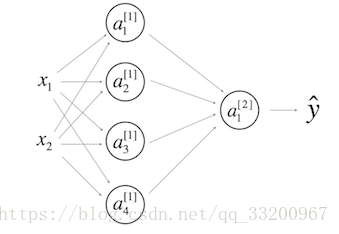
- \( b^{[1]} \) should have shape (4, 1)
- \( b^{[2]} \) should have shape (1, 1)
- \( W^{[1]} \) should have shape (4, 2)
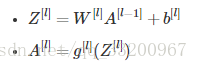
- \( W^{[2]} \) should have shape (1, 4) - For the \( l \)-th layer (where \( 1 \leq l \leq L \)), the correct vectorized forward propagation formula is:
Deep Neural Networks
- Using “cache” in forward and backward propagation records values computed during forward passes to enable backward pass calculations via the chain rule.
- Hyperparameters include: number of iterations, learning rate, number of layers \( L \), and number of hidden units.
- Deep neural networks can handle more complex input features than shallow networks.
- The following 4-layer network has 3 hidden layers:
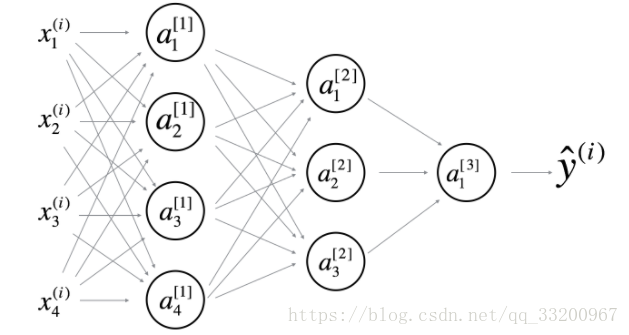
- Layer count: Hidden layers + 1 (input and output layers are not counted as hidden layers). - In forward propagation, the activation function (sigmoid, tanh, ReLU, etc.) must be specified because the derivative for backward propagation depends on it.
- Shallow networks require larger circuits (measured by the number of logic gates) for computations, while deep networks can achieve the same with exponentially smaller circuits.
- A 2-hidden-layer neural network:
[Image not available in original repository]
- (i) \( W^{[1]} \) shape: (4, 4) (calculation: \( W^{[l]} = (n^{[l]}, n^{[l-1]}) \)), \( W^{[2]} = (3, 4) \), \( W^{[3]} = (1, 3) \)
- (ii) \( b^{[1]} \) shape: (4, 1) (calculation: \( b^{[l]} = (n^{[l]}, 1) \)), \( b^{[2]} = (3, 1) \), \( b^{[3]} = (1, 1) \) - To initialize model parameters using the
layer_dimsarray[n_x, 4, 3, 2, 1](4 hidden units in layer 1, etc.):
for i in range(1, len(layer_dims)):
  parameter['W' + str(i)] = np.random.randn(layers[i], layers[i-1]) * 0.01
  parameter['b' + str(i)] = np.random.randn(layers[i], 1) * 0.01
This note is based on studying Andrew Ng’s courses. As a beginner, if there are any misunderstandings, please feel free to correct me!