Table of Contents
@[toc]
Practical Aspects of Deep Learning
- For 10,000,000 examples, the dataset split is generally 98% training, 1% validation, 1% test.
- Validation and test datasets usually come from the same distribution.
- When there are large gaps between the performance of different neural network models, the general solution is to increase the dataset size and add regularization.
- When the training set error is small but the validation set error is large, increasing the regularization lambda value and expanding the dataset are typically recommended.
- Increasing the regularization hyperparameter lambda pushes weights towards smaller values, closer to zero.
- Increasing the parameter keep_prob from (e.g.) 0.5 to 0.6 may reduce regularization effect, potentially leading to lower training set errors.
- Increasing training data, adding Dropout, and applying regularization techniques can reduce variance (alleviate overfitting).
- Weight decay is a regularization technique (e.g., L2 regularization) that causes gradient descent to shrink weights in each iteration.
- We normalize the input data X because it helps the loss function converge faster during optimization.
- When using the reverse dropout method during testing, dropout (randomly eliminating units) should not be applied, nor should the 1/keep_prob scaling factor used during training calculations.
Optimization Algorithms
- When the input is the 7th example of the 8th minibatch, the activation of the 3rd layer is represented as: \(a^{[3]\{8\}(7)}\).
- One iteration of Mini-batch Gradient Descent (computed on a single minibatch) is faster than one iteration of Batch Gradient Descent.
- The optimal minibatch size is usually between 1 and m, not 1 or m. 1) Using a minibatch size of 1 loses vectorization benefits within the minibatch. 2) Using a minibatch size of m results in Batch Gradient Descent, which requires processing the entire training set before completing one iteration.
- Suppose the cost function J of a learning algorithm is plotted against the number of iterations, as shown:
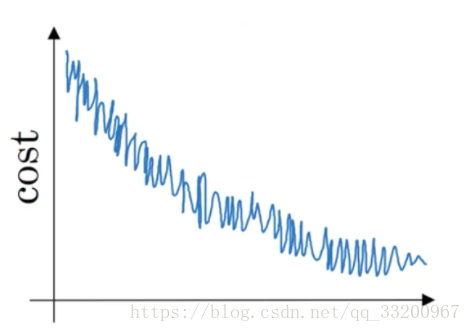
From the plot, if using Mini-batch Gradient Descent, it appears acceptable. If using Batch Gradient Descent, something is wrong. - Suppose the temperature in Casablanca was the same for the first three days of January:
- January 1st: \(\theta_1 = 10^\circ C\)
- January 2nd: \(\theta_2 = 10^\circ C\)
Using exponential weighted averages with \(\beta=0.5\) to track temperature: \(v_0 = 0, v_t = \beta v_{t-1} + (1-\beta)\theta_t\). After 2 days: \(v_2 = 7.5\), and the corrected bias value is: \(v_2^{corrected} = 10\). - \(\alpha = e^t \alpha_0\) is not a good learning rate decay method, where t is the epoch number. Better methods include: \(\alpha = 0.95^t \alpha_0\), \(\alpha = \frac{1}{\sqrt{t}} \alpha_0\), or \(\alpha = \frac{1}{1+2t} \alpha_0\).
- Using exponential weighted averages on London temperature dataset: \(v_{t} = \beta v_{t-1} + (1-\beta)\theta_t\). The red line uses \(\beta=0.9\).
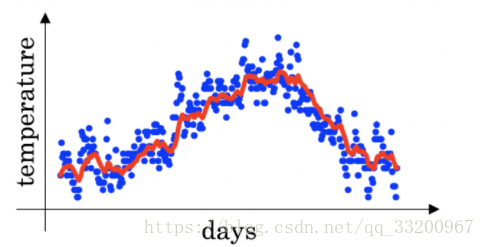
Increasing \(\beta\) shifts the red line slightly to the right; decreasing \(\beta\) introduces more oscillations around the line. - The plot:
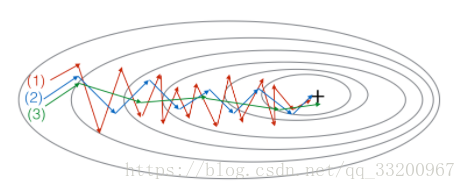
Shows Gradient Descent, Momentum Gradient Descent (\(\beta=0.5\)), and Momentum Gradient Descent (\(\beta=0.9\)). (1) is Gradient Descent, (2) is Momentum (small \(\beta\)), (3) is Momentum (large \(\beta\)). - If Batch Gradient Descent in a deep network takes too long to find parameters minimizing \(\mathcal{J}(W^{[1]},b^{[1]},..., W^{[L]},b^{[L]})\), try: 1) Adjust learning rate \(\alpha\); 2) Better random weight initialization; 3) Use Mini-batch Gradient Descent; 4) Use Adam.
- Correct statements about Adam: 1) Learning rate \(\alpha\) often needs adjustment; 2) Default hyperparameters are \(\beta_1=0.9, \beta_2=0.999, \varepsilon=10^{-8}\); 3) Adam combines RMSProp and Momentum advantages.
Hyperparameter Tuning, Batch Normalization, and Programming Frameworks
- For searching large hyperparameter spaces, random sampling is preferred over grid search.
- Not all hyperparameters impact training equally; learning rate is often more critical than others.
- During hyperparameter search, whether to use “panda” (single model optimization) or “caviar” (parallel model training) depends on available computational resources.
- For sampling \(\beta\) (momentum hyperparameter) between 0.9 and 0.99:
r = np.random.rand()
beta = 1 - 10**(-r - 1)
- After finding good hyperparameters, they need re-tuning when network architecture or other hyperparameters change.
- In Batch Normalization, when applied to the first layer of your neural network, \(z^{[l]}\) is normalized using the formula.
- In the normalization formula \(z_{norm}^{(i)} = \frac{z^{(i)} - \mu}{\sqrt{\sigma^2 + \varepsilon}}\), \(\varepsilon\) is used to prevent division by zero in \(z^{(i)} - \mu\).
- For \(\gamma\) and \(\beta\) in Batch Normalization, they can be learned using Adam, Momentum, or RMSprop (not just Gradient Descent) and model the linear transformation of the normalized \(z^{[l]}\).
- During Batch Normalization, use exponentially weighted averages of \(\mu\) and \(\sigma^2\) over training minibatches for estimation.
- In deep learning frameworks, even open-source projects benefit from good governance to ensure long-term openness. Programming frameworks allow writing deep learning algorithms with fewer lines of code than low-level languages like Python.