Table of Contents
@[toc]
Introduction
Backpropagation computes the gradient \(\frac{\partial J}{\partial \theta}\), where \(\theta\) represents the model parameters. \(J\) is calculated using forward propagation and a loss function. The formula is:
$$ \frac{\partial J}{\partial \theta} = \lim_{\varepsilon \to 0} \frac{J(\theta + \varepsilon) - J(\theta - \varepsilon)}{2 \varepsilon} \tag{1}$$
Since forward propagation is relatively easy to implement and verify, we first ensure \(J\) is computed correctly. This allows us to validate the gradient calculation \(\frac{\partial J}{\partial \theta}\) using the numerical approximation method.
1D Gradient Check
For a linear function \(J(\theta) = \theta x\), the model has one real-valued parameter \(\theta\) with input \(x\).
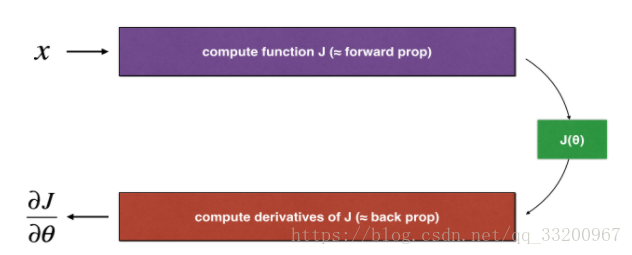
The diagram shows key steps: forward propagation (calculating \(J\)) and backward propagation (calculating \(\frac{\partial J}{\partial \theta}\)).
Import Dependencies
First, import required libraries. Some utilities can be downloaded from here.
# coding=utf-8
from testCases import *
from gc_utils import sigmoid, relu, dictionary_to_vector, vector_to_dictionary, gradients_to_vector
Forward Propagation
Linear forward propagation function:
def forward_propagation(x, theta):
    """
    Implements forward propagation for J(theta) = theta * x

    Arguments:
    x -- input value (scalar)
    theta -- parameter (scalar)

    Returns:
    J -- value of function J
    """
    J = theta * x
    return J
Backward Propagation
Linear backward propagation function:
def backward_propagation(x, theta):
    """
    Computes the derivative of J with respect to theta

    Arguments:
    x -- input value (scalar)
    theta -- parameter (scalar)

    Returns:
    dtheta -- gradient of J with respect to theta
    """
    dtheta = x
    return dtheta
Gradient Check Execution
To check the gradient:
1. Compute \(\theta^{+} = \theta + \varepsilon\) and \(\theta^{-} = \theta - \varepsilon\)
2. Calculate \(J^{+} = J(\theta^{+})\) and \(J^{-} = J(\theta^{-})\)
3. Approximate gradient: \(gradapprox = \frac{J^{+} - J^{-}}{2\varepsilon}\)
4. Compare with backward propagation result using:
$$ difference = \frac{|\text{grad} - \text{gradapprox}|_2}{|\text{grad}|_2 + |\text{gradapprox}|_2} \tag{2}$$
def gradient_check(x, theta, epsilon=1e-7):
    """
    Implements gradient checking

    Arguments:
    x -- input value (scalar)
    theta -- parameter (scalar)
    epsilon -- small shift to compute approximated gradient

    Returns:
    difference -- difference between grad and gradapprox
    """
    thetaplus = theta + epsilon  # Step 1
    thetaminus = theta - epsilon  # Step 2
    J_plus = thetaplus * x  # Step 3
    J_minus = thetaminus * x  # Step 4
    gradapprox = (J_plus - J_minus) / (2 * epsilon)  # Step 5

    grad = backward_propagation(x, theta)  # Get backward propagation gradient

    numerator = np.linalg.norm(grad - gradapprox)  # Step 1'
    denominator = np.linalg.norm(grad) + np.linalg.norm(gradapprox)  # Step 2'
    difference = numerator / denominator  # Step 3'

    if difference < 1e-7:
        print("Gradient is correct!")
    else:
        print("Gradient is incorrect!")

    return difference

if __name__ == "__main__":
    x, theta = 2, 4
    difference = gradient_check(x, theta)
    print("difference = " + str(difference))
Output:
Gradient is correct!
difference = 2.91933588329e-10
Multi-dimensional Gradient Check
For multi-dimensional parameters, we extend the gradient check to parameter dictionaries.
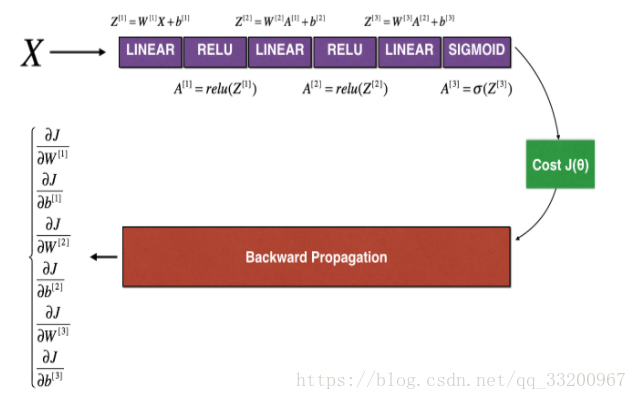
LINEAR -> RELU -> LINEAR -> RELU -> LINEAR -> SIGMOID
Forward Propagation
Multi-dimensional forward propagation:
def forward_propagation_n(X, Y, parameters):
    """
    Implements forward propagation (and computes cost)

    Arguments:
    X -- training set, shape (input size, m)
    Y -- labels, shape (1, m)
    parameters -- dictionary of parameters (W1, b1, W2, b2, W3, b3)

    Returns:
    cost -- computed cost
    cache -- intermediate values for backward propagation
    """
    m = X.shape[1]
    W1 = parameters["W1"]
    b1 = parameters["b1"]
    W2 = parameters["W2"]
    b2 = parameters["b2"]
    W3 = parameters["W3"]
    b3 = parameters["b3"]

    Z1 = np.dot(W1, X) + b1
    A1 = relu(Z1)
    Z2 = np.dot(W2, A1) + b2
    A2 = relu(Z2)
    Z3 = np.dot(W3, A2) + b3
    A3 = sigmoid(Z3)

    logprobs = np.multiply(-np.log(A3), Y) + np.multiply(-np.log(1 - A3), 1 - Y)
    cost = 1. / m * np.sum(logprobs)

    cache = (Z1, A1, W1, b1, Z2, A2, W2, b2, Z3, A3, W3, b3)
    return cost, cache
Backward Propagation
Multi-dimensional backward propagation:
def backward_propagation_n(X, Y, cache):
    """
    Implements backward propagation

    Arguments:
    X -- input data
    Y -- true labels
    cache -- output from forward_propagation_n

    Returns:
    gradients -- dictionary of gradients
    """
    m = X.shape[1]
    (Z1, A1, W1, b1, Z2, A2, W2, b2, Z3, A3, W3, b3) = cache

    dZ3 = A3 - Y
    dW3 = 1. / m * np.dot(dZ3, A2.T)
    db3 = 1. / m * np.sum(dZ3, axis=1, keepdims=True)

    dA2 = np.dot(W3.T, dZ3)
    dZ2 = np.multiply(dA2, np.int64(A2 > 0))
    dW2 = 1. / m * np.dot(dZ2, A1.T) * 2  # ERROR: Should be 1.0
    db2 = 1. / m * np.sum(dZ2, axis=1, keepdims=True)

    dA1 = np.dot(W2.T, dZ2)
    dZ1 = np.multiply(dA1, np.int64(A1 > 0))
    dW1 = 1. / m * np.dot(dZ1, X.T)
    db1 = 4. / m * np.sum(dZ1, axis=1, keepdims=True)  # ERROR: Should be 1.0

    gradients = {"dZ3": dZ3, "dW3": dW3, "db3": db3,
                 "dA2": dA2, "dZ2": dZ2, "dW2": dW2, "db2": db2,
                 "dA1": dA1, "dZ1": dZ1, "dW1": dW1, "db1": db1}
    return gradients
Multi-dimensional Gradient Check
Iterate over each parameter to compute approximation:
def gradient_check_n(parameters, gradients, X, Y, epsilon=1e-7):
    """
    Checks if backward_propagation_n computes gradients correctly

    Arguments:
    parameters -- dictionary of parameters
    gradients -- gradients from backward_propagation_n
    X -- input data
    Y -- labels
    epsilon -- small shift to compute approximated gradient

    Returns:
    difference -- difference between grad and gradapprox
    """
    parameters_values, _ = dictionary_to_vector(parameters)
    grad = gradients_to_vector(gradients)
    num_parameters = parameters_values.shape[0]
    J_plus = np.zeros((num_parameters, 1))
    J_minus = np.zeros((num_parameters, 1))
    gradapprox = np.zeros((num_parameters, 1))

    for i in range(num_parameters):
        thetaplus = np.copy(parameters_values)
        thetaplus[i][0] += epsilon
        J_plus[i], _ = forward_propagation_n(X, Y, vector_to_dictionary(thetaplus))

        thetaminus = np.copy(parameters_values)
        thetaminus[i][0] -= epsilon
        J_minus[i], _ = forward_propagation_n(X, Y, vector_to_dictionary(thetaminus))

        gradapprox[i] = (J_plus[i] - J_minus[i]) / (2 * epsilon)

    numerator = np.linalg.norm(grad - gradapprox)
    denominator = np.linalg.norm(grad) + np.linalg.norm(gradapprox)
    difference = numerator / denominator

    if difference > 2e-7:
        print("\033[93m" + "Backpropagation has errors! difference = " + str(difference) + "\033[0m")
    else:
        print("\033[92m" + "Backpropagation is correct! difference = " + str(difference) + "\033[0m")
    return difference

if __name__ == "__main__":
    X, Y, parameters = gradient_check_n_test_case()
    cost, cache = forward_propagation_n(X, Y, parameters)
    gradients = backward_propagation_n(X, Y, cache)
    difference = gradient_check_n(parameters, gradients, X, Y)
Initial Output (with errors):
Backpropagation has errors! difference = 0.285093156781
After fixing errors in dW2 and db1:
dW2 = 1. / m * np.dot(dZ2, A1.T)  # Corrected: 1.0 instead of 2
db1 = 1. / m * np.sum(dZ1, axis=1, keepdims=True)  # Corrected: 1.0 instead of 4
Corrected Output:
Backpropagation is correct! difference = 1.18904178766e-07
References
- http://deeplearning.ai/
This note is based on Andrew Ng’s course. For beginners, feel free to correct any misunderstandings!