Preface
PaddlePaddle, also known as Paddle, was originally a deep learning framework independently developed by Baidu in 2013. At the Baidu World Congress in September 2016, Baidu’s Chief Scientist Andrew Ng first announced the open-sourcing of the PaddlePaddle deep learning framework, which is China’s first open-source deep learning framework. The author began to contact PaddlePaddle in 2017. Since the open-source time was relatively short then, the relevant materials were quite limited. To enable more developers to familiarize themselves with this framework, the author wrote “My Learning Journey with PaddlePaddle” and several practical tutorials on the CSDN blog. Additionally, the author published a book titled “Practical Deep Learning with PaddlePaddle”.
With the iterative updates of PaddlePaddle versions, in 2018, PaddlePaddle officially launched the Fluid version. Compared to previous versions, the Fluid version is easier to use, offers better training efficiency, and facilitates deployment on various devices. Therefore, the author conceived the idea of publishing a tutorial book for the PaddlePaddle Fluid version. In the second half of 2018, the author started designing the book’s table of contents and then began writing the tutorials. The first draft was completed by the end of 2019. However, due to various difficulties, the book was delayed for over a year without a publication opportunity. During this period, the author did not idle away; instead, they continuously upgraded and fixed the code. Finally, with the joint efforts of the author and the publisher’s editors, the final manuscript was submitted to the publisher earlier this year, and the book is now officially available.
Book Introduction
The appearance of this book is as follows:
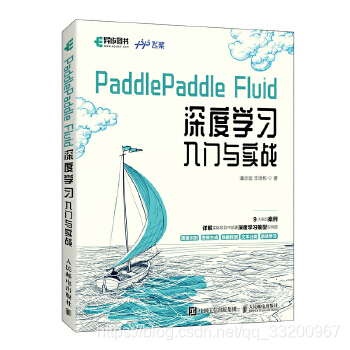
After studying the learning paths of many developers to get started with deep learning frameworks and combining the author’s personal learning experience, the author decided on the following table of contents structure. This book not only introduces how to get started with PaddlePaddle but also enables readers to solve practical problems such as project design and enterprise application development through it.
- Chapter 1: Setting up the PaddlePaddle Deep Learning Development Environment
- Chapter 2: Quick Start with PaddlePaddle
- Chapter 3: PaddlePaddle’s HelloWorld - Linear Regression Algorithm
- Chapter 4: Convolutional Neural Network Practical - MNIST Handwritten Digit Recognition
- Chapter 5: Recurrent Neural Network Practical - Sentiment Analysis of Movie Review Dataset
- Chapter 6: Generative Adversarial Network Practical - Dataset Augmentation
- Chapter 7: Reinforcement Learning Practical - Becoming Smarter Through Game Feedback
- Chapter 8: Saving and Using PaddlePaddle Models
- Chapter 9: Transfer Learning Practical - Flower Species Recognition
- Chapter 10: Using PaddlePaddle Visualization Tool VisulDL
- Chapter 11: Practical Project for Custom Image Dataset Recognition - Fruit Recognition
- Chapter 12: Practical Project for Custom Text Dataset Classification - News Title Classification
- Chapter 13: Using PaddlePaddle Dynamic Graph
- Chapter 14: Developing AI-Powered Server Interfaces
- Chapter 15: Practical Project for Mobile Deep Learning Framework Paddle-Lite - Fruit Recognition App
Book Source Code: https://github.com/yeyupiaoling/PaddlePaddleCourse
Online Running Address: https://aistudio.baidu.com/aistudio/projectdetail/2021224
Version Information:
- Stable-supported version: PaddlePaddle 1.8.5 (Chapter 13 only supports PaddlePaddle 2.0.0a0)
- Latest compatible version: PaddlePaddle 2.1.0
Purchase Methods
If readers are interested in artificial intelligence, they can purchase this book to learn PaddlePaddle. The book is available on major platforms. If you encounter any problems while using this book, you can also exchange views through messages.
It seems there will be a 25% discount during the 618 promotion period.