Since I started getting in touch with the PaddlePaddle deep learning framework in 2017, I have loved this framework. Because it is the first domestically developed open-source deep learning framework, allowing access to domestic resources related to PaddlePaddle. I could almost communicate face-to-face with PaddlePaddle developers, which I have personally experienced. Therefore, with the help of my mentor and the editor from Posts & Telecom Press, I successfully completed the book “Deep Learning Practice with PaddlePaddle”.
The entire book avoids mathematical formulas as much as possible, using deep learning image recognition cases throughout, starting from simple handwritten digit recognition and CIFAR color image recognition; moving on to widely used applications in daily life such as captcha recognition, license plate recognition, and scene text recognition; and then extending to deep learning applications on mobile and server ends.
It focuses on helping readers develop practical application development and problem-solving abilities for PaddlePaddle deep learning.
Book Introduction
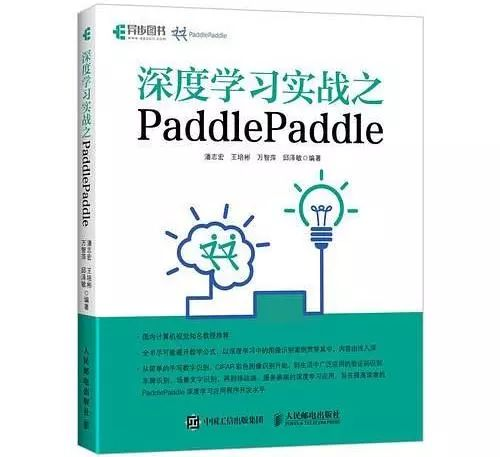
This book comprehensively explains the deep learning framework PaddlePaddle and combines typical cases to elaborate on its specific applications. The book consists of 15 chapters.
- Chapter 1 introduces deep learning and its mainstream frameworks;
- Chapter 2 presents several different installation methods for PaddlePaddle;
- Chapter 3 implements handwritten digit recognition using the MNIST dataset;
- Chapter 4 covers CIFAR color image recognition;
- Chapter 5 introduces recognition using custom datasets;
- Chapter 6 discusses captcha recognition;
- Chapter 7 explores scene text recognition;
- Chapter 8 implements end-to-end captcha recognition;
- Chapters 9-11 explain license plate recognition and object detection using the SSD neural network;
- Chapters 12 and 13 introduce Fluid and the visualization tool VisualDL;
- Chapters 14 and 15 detail how to practice projects using PaddlePaddle on server and Android mobile terminals.
This book is suitable for machine learning enthusiasts, programmers, and practitioners in the field of artificial intelligence. It can also be used as a textbook for teachers and students in related majors at colleges and universities, as well as a training material for training schools.
Author’s Sharing
Actually, before getting in touch with PaddlePaddle, the AI technologies I used, such as face recognition, were just by calling third-party API interfaces, and I had no knowledge of AI at all. By chance, I learned about PaddlePaddle, this deep learning framework, and tried to learn it. During the learning process, PaddlePaddle’s engineering support was a great help, enabling me to quickly master its basic usage. In 2017, there were very few resources available for PaddlePaddle online, and I encountered many problems during learning.
I have a habit of writing blogs, so I decided to write a series of PaddlePaddle tutorials on my blog at that time.
After several months of learning, I finally completed the “My PaddlePaddle Learning Journey” tutorial column. My teacher, upon learning about this column, suggested that I turn it into a book. By chance, I met an editor from Posts & Telecom Press, and shared my and my teacher’s idea with him, and he was very supportive. Then, I organized this series with my teachers into a book. Finally, it was officially released at the end of May this year.
When writing these tutorials, I didn’t intend to turn them into a book. I just wanted to help more students learning PaddlePaddle by providing quick access to the tutorials they needed through blog posts. Unexpectedly, this effort turned into a book. I am very grateful to my teachers and the editor from Posts & Telecom Press. Without them, there would be no publication of “Deep Learning Practice with PaddlePaddle”. I hope this book can help more students learning PaddlePaddle and that they can gain something from it.
If you haven’t found what you like yet, keep exploring and don’t rush to decide. Just like everything should be done by feeling, once you find something you love, your heart will tell you. Just like any wonderful thing, it becomes more precious over time. So, keep searching until you find what you love.
Finally, here is the purchase link for our book, hoping that those interested in PaddlePaddle can gain inspiration from the practical cases in this book.
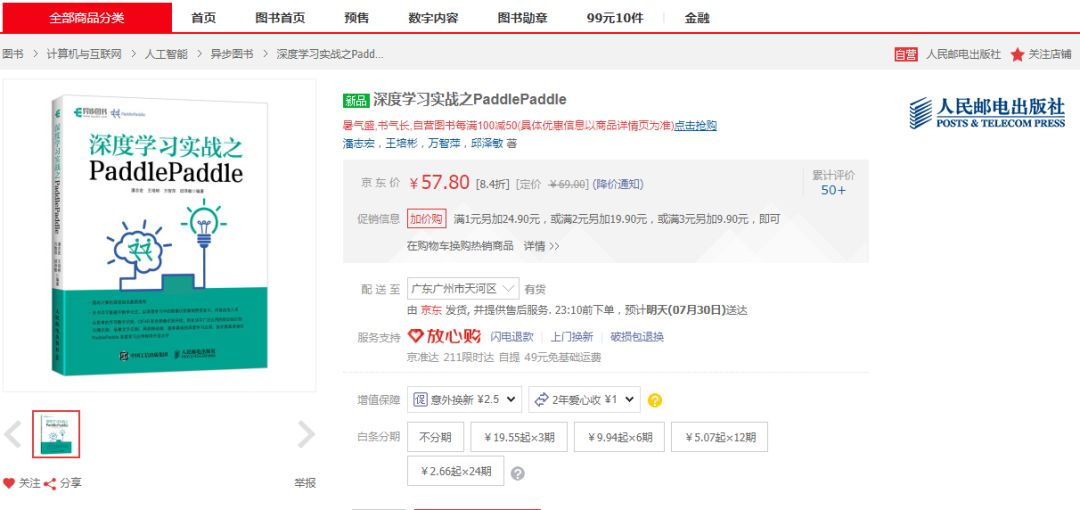
- JD.com purchase link: https://item.jd.com/12618064.html#
- Tmall purchase link: https://detail.tmall.com/item.htm?id=595752914149